
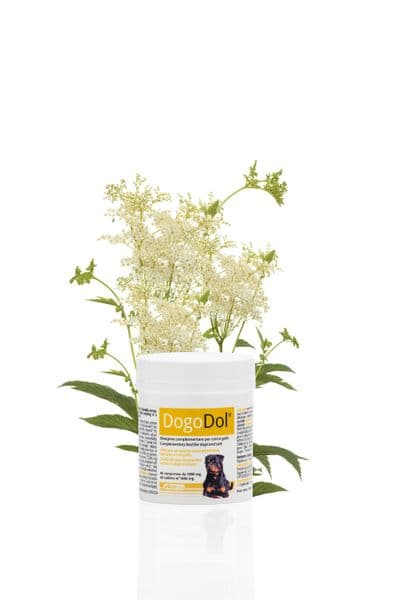
Dogoteka DogoDol ist ein diätetisches Ergänzungsfuttermittel für Hunde und Katzen mit neuroprotektiver, schmerzlindernder und entzündungshemmender Wirkung, ein „pflanzliches Schmerzmittel" auf Basis von PEA (Palmitoylethanolamid), Mädesüß, Weihrauch, Olivenbaum-Extrakt und Vitamin C. Unterstützt die körpereigene Immunabwehr, verbessert die Lebensqualität kranker Tiere und trägt zu einer schnelleren Genesung bei.
Alle Preise inkl. MwSt. zzgl. Versandkosten.
Dogoteka DogoDol
47,99 €61,99 €Dogodol® is a complementary feed for dogs and cats indicated for a neuroprotective action.Active ingredients: Palmitoylethanolamide (PEA) – from a chemical point of view, PEA is the amide of palmitic acid with ethanolamine. It is an endogenous molecule that is particularly abundant in brain tissues. It is also present in many foods such as soy, tomatoes, eggs, peanuts, peas, etc. PEA is synthesized at the endogenous level, following stimuli capable of evoking an immune response; several studies have shown how endogenous levels of PEA can be altered following inflammatory processes. PEA is known for its antioxidant properties; at the cellular level this can translate into a neuroprotective effect. Unsaponifiable fraction of avocado and soy – avocado oil and soybean oil, like all oils, consist of a predominant component called “saponifiable fraction” consisting of triglycerides, diglycerides and monoglycerides and a component called “unsaponifiable fraction” consisting of a series of secondary compounds. The unsaponifiable fraction of an oil is the chemical component which, in contact with caustic soda, does not react, therefore remaining in solution. It is rich in different chemical constituents which vary according to the type of oil. In Avocado oil it represents about 2-12% of the oil and is mainly made up of phytosterols, terpenic alcohols, avocatins, volatile acids and fat-soluble vitamins, including vitamin E; in soybean oil it represents about 2% of the oil and consists mainly of soy lecithin and phytosterols. The set of these two fractions constitutes the ingredient ASU-Avovida® which has been the subject of several studies that have highlighted the health effects at both joint and muscle level, in particular they have highlighted a chondroprotective action, which seems to be associated with an increase in collagen synthesis in joint chondrocytes mainly due to phytosterols (Beta-Sitosterol, Beta-Sitosterologlucoside, Stigmasterol, Capesterol) which are among the major components of ASU-Avovida®. Spirea ulmaria – it is a perennial herbaceous plant belonging to the Rosaceae family. It grows spontaneously in humid mountainous and hilly areas, especially along watercourses. The flowering tops of this plant are mainly used, which are harvested in June-July, when flowering begins. At the beginning of the 19th century, salicylic acid was isolated for the first time from Spirea ulmaria, a precursor of the well-known “aspirin” produced synthetically and whose name derives from this plant. Phytochemical analyzes have shown that the “Filipendula” species are particularly rich in polyphenols, including flavonoic glycosides and ellagitannins. In vitro studies have shown that the polyphenols of Spirea Ulmaria have antioxidant properties and are also able to inhibit the synthesis of various mediators of the immune response, such as eg. prostaglandin E2 (PGE2) and thromboxane B2 (TXB2). Phytosterols – phytosterols are plant sterols particularly abundant in vegetable oils, nuts, legumes, seeds, cereals, fresh fruit and vegetables. From a chemical point of view they are similar to cholesterol and therefore, by mimicking its structure, due to steric hindrance, they can reduce its absorption in the intestine by controlling its plasma levels. In the last 15 years, several studies have highlighted further equally important properties of phytosterols including a certain immunological activity. Their activity at the immune level seems to be mainly at the level of specific lymphocytes, or helper T lymphocytes (TH1 and TH2), helping to maintain normal functioning and therefore supporting specific immunity. Boswellia serrata Roxb. ex Colebr.: – olibanum extract: Boswellia serrata is a moderately to large branched tree of the Burseraceae family. It grows in arid mountainous areas of India, North Africa and the Middle East. The drug, or the part of the plant used, is the gum-oily resin that is taken by incision made on the trunk of the tree and which is then stored in a bamboo basket specially made to remove the oil and solidify the resin. Boswellia oleo-gum-resins contain about 30-60% of resin, 5-10% of essential oils and the rest is made up of polysaccharides. The resinous part of Boswellia serrata consists mainly of mono, di and triterpenes and pentacyclic triterpene acids such as β-boswellic acid, acetyl-β-boswellic acid, 11-keto-β-boswellic acid and acetyl-11-keto- β-boswellic. Studies in vitro and on animal models have shown that boswellic acids intervene by inhibiting the synthesis of some immune response mediators such as the 5-lipoxygenase enzyme and leukotrienes which promote free radical damage. Olea europaea L . – olive tree extract: The olive tree (Olea europea L.) is a fruit tree grown in many parts of the world, but the Mediterranean region is the main production area. The main product obtained from the olive tree is the oil extracted from the fruits, a fleshy ellipsoidal or ovoid drupe formed by a pulp that contains the oil and a woody and wrinkled stone. Olive oil is widely studied for its antioxidant power due to the large number of phenolic components. However, it is above all the olive leaves that contain the greatest quantity of these substances. Phenolic compounds are products of the secondary metabolism of plants. In the case of the olive tree, they are a consequence of the reactivity to the attack of the pathogens and the response to the injuries of the insects. Five groups of phenolic compounds have been identified in the olive tree: oleuropeosides (oleuropein and verbascoside); flavones (luteolin-7-glucoside, apigenin-7-glucoside, diosmetina-7-glucoside, luteolin and diosmetina); flavonols (rutin); flavan-3-oils (catechin) and phenolic derivatives (tyrosol, hydroxytyrosol, vanillin, vanillic acid and caffeic acid). Phenolic compounds are known for their antioxidant properties or neutralizing free radicals. Free radicals are products that are generated by physiological chemical reactions that use oxygen and are highly reactive chemical species. When there is an excess production of these substances, oxidative damage can occur at the cellular level. This cellular damage is related to the increased risk of developing chronic diseases, therefore the intake of substances with antioxidant action is assumed to be useful to minimize oxidative damage. Vitamin C – is a water-soluble vitamin and is an essential ingredient, as it is not synthesized independently by different mammals. It is mainly found in foods of plant origin such as some fresh sour fruits (citrus fruits, pineapple, strawberries, cherries, etc.), fresh vegetables (lettuce, radicchio, spinach, etc.), fresh vegetables (broccoli, cabbage, tomatoes , peppers etc …) and tubers (potatoes). It is a powerful antioxidant and cofactor for a family of biosynthetic and gene-regulating enzymes. Vitamin C contributes to immune defense by supporting various cellular functions of both the innate and adaptive immune systems. It plays an important role as an epithelial barrier against pathogens and promotes the scavenging activity of the skin against oxygen radicals, thus potentially protecting against environmental oxidative stress. Vitamin C accumulates in phagocytic cells such as neutrophils and can enhance chemotaxis, phagocytosis and the generation of reactive oxygen species and ultimately microbial killing. It also intervenes in the mechanism of cellular apoptosis and in the elimination of exhausted neutrophils from the sites of infection by macrophages, thus reducing necrosis and potential tissue damage. The role of vitamin C at the level of specific or so-called adaptive immunity cells is less clear, but some studies have shown that vitamin C improves the differentiation and proliferation of B and T cells (specific immunity cells), probably a due to its gene regulatory effects. Vitamin C deficiencies can lead to reduced immunity. Supplementing with vitamin C can therefore be particularly indicated as a support to immune functions. BibliographyPalmitoylethanolamide is a disease-modifying agent in peripheral neuropathy: pain relief and neuroprotection share a PPAR-alpha-mediated mechanism. Mediators Inflamm. 2013;2013:328797. -Di Cesare Mannelli L, D’Agostino G, Pacini A, Russo R, Zanardelli M, Ghelardini C, Caligna¬no A. Neuroprotective activities of pal¬157 mitoylethanolamide in an animal model of Parkinson’s disease. PLoS One. 2012;7(8):e41880.Esposito E, Impellizzeri D, Mazzon E, Paterniti I, Cuzzocrea S. Molecular evidence for the involvement of PPAR-δ and PPAR-γ in anti-inflammatory and neuroprotective ac¬tivities of palmitoylethanolamide after spinal cord trauma. J Neuroinflammation; 2013;10(1):20.Paterniti I, Impellizzeri D, Crupi R, Morabito R, Campolo M, Esposito E, Cuzzocrea S. Palmitoylethanolamide controls reactive gliosis and exerts neuroprotective functions in a rat model of Alzheimer’s disease.C Scuderi, C Stecca, M Valenza, P Ratano, MR Bronzuoli, S Bartoli, L Steardo, E Pompili, L Fumagalli, P Campolongo and L Steardo Symptoms modifying effect of avocado/soybean unsaponifiables (ASU) in knee osteoarthritis. A double blind, prospective, placebo-controlled study. Scand J Rheumatol 2001;30(4):242-247.Appelboom, T., Schuermans, J., Verbruggen, G., Henrotin, Y., and Reginster, J. Y. The possible “chondroprotective” effect of the unsaponifiable constituents of avocado and soya in vivo. Drugs Exp.Clin.Res. 1998;24(1):41-50.Khayyal, M. T. and el Ghazaly, M. A. Avocado soybean unsaponifiables (ASU) suppress TNF-alpha, IL-1beta, COX-2, iNOS gene expression, and prostaglandin E2 and nitric oxide production in articular chondrocytes and monocyte/macrophagesR Y Au , T K Al-Talib, A Y Au, P V Phan, C G Frondoza Antioxidant, anti-inflammatory and gastroprotective activity of Filipendula ulmaria (L.) Maxim. and Filipendula vulgaris MoenchStevan Samardžić, Jelena Arsenijević, Dragana Božić, Marina Milenković, Vele Tešević, Zoran Maksimović Plant Sterols and Sterolins: A Review of Their Immune-Modulating PropertiesPatrick J.D. Bouic, PhD and Johan H. Lamprecht, MD Boswellia Serrata, A Potential Antiinflammatory Agent: An Overview M. Z. SIDDIQUI*Processing and Product Development Division, Indian Institute of Natural Resins and Gums, Namkum, Ranchi-834 010, India Polyphenols benefits of olive leaf (Olea europaea L) to human healthPatricia Vogel, Isabel Kasper Machado, Juliano Garavaglia, Valdeni Terezinha Zani, Daiana de Souza and Simone Morelo Dal Bosco. Vitamin C and Immune FunctionAnitra C Carr, Silvia Maggini The role of vitamin C in the treatment of pain: new insightsAnitra C Carr, Cate McCall
Mädesüß enthält die natürliche Vorstufe der Salicylsäure — das Wirkprinzip, aus dem später das synthetische Aspirin entwickelt wurde.
Der Wirkstoff aktiviert das körpereigene Immunsystem gegen Entzündungen und wirkt auf zellulärer Ebene neuroprotektiv.
Die unverseifbaren Anteile von Avocado- und Sojaöl steigern nachweislich die Kollagensynthese in Gelenkchondrozyten — relevant bei allem, was Gelenke betrifft.
Boswelliasäuren hemmen die Synthese von 5-Lipoxygenase und Leukotrienen, die Schäden durch freie Radikale fördern.
durch chronische oder akute Entzündungsprozesse.
, bei denen die chondroprotektive Komponente von ASU-Avovida® gefragt ist.
, deren Lebensqualität verbessert werden soll.
nach Krankheit oder Operation.
, bei denen der Krankheitsverlauf verzögert und Nervengewebe geschützt werden soll.
Gabe über 7 bis 10 aufeinanderfolgende Tage zur Unterstützung von Heilung und Rekonvaleszenz.
Kur über 7 bis 10 Tage, bei ausbleibender Besserung um weitere 10 Tage verlängern.
Regelmäßige Kuren, um Lebensqualität und Beweglichkeit zu erhalten.
Für die bestmögliche Wirkung empfiehlt der Hersteller die gleichzeitige Gabe von DOGOteka MultiAdapt®.
Halbe Tablette täglich, am einfachsten zerkleinert unter das Nassfutter gemischt.
Zeitlich begrenzte Kur zur Unterstützung des Körpers während der akuten Phase.
„Pflanzliches Schmerzmittel" ist ein großes Versprechen — DogoDol löst es über mehrere, sich ergänzende Wirkprinzipien ein statt über einen einzelnen Extrakt. PEA ist ein körpereigenes Molekül, das gezielt an der Entzündungsantwort ansetzt; Mädesüß bringt die historische Salicylsäure-Vorstufe ein; Weihrauch hemmt Entzündungsmediatoren auf enzymatischer Ebene; ASU-Avovida® wirkt zusätzlich chondroprotektiv auf den Gelenkknorpel. Der neuroprotektive Ansatz, Nervenzellen vor dem Absterben zu bewahren, um den Krankheitsverlauf zu verzögern, hebt das Produkt von reinen Schmerzpräparaten ab.
Für Halter älterer oder chronisch kranker Tiere ist genau das der entscheidende Punkt: nicht nur Symptome dämpfen, sondern Lebensqualität erhalten.
Je nach Gewicht des Tieres an etwa 7 bis 10 aufeinanderfolgenden Tagen. Bleibt die Besserung aus, kann die Gabe um weitere 10 Tage fortgesetzt werden.
Nach Tierart und Körpergewicht — die Tablettenmengen je Gewichtsklasse stehen in der Dosiertabelle.
Palmitoylethanolamid, ein körpereigenes Molekül, das besonders häufig im Gehirngewebe vorkommt. Es ist für seine antioxidativen Eigenschaften bekannt und kann neuroprotektiv wirken.
Der Versuch, Nervenzellen und Nervenfasern vor dem Absterben zu bewahren, um den Krankheitsverlauf zu verzögern und die Lebensqualität zu verbessern.
Nein. DogoDol ist ein diätetisches Ergänzungsfuttermittel und ersetzt keine tierärztliche Diagnose oder Therapie.
Für dieses Produkt gibt es noch keine Bewertung. Wenn du es kennst, hilfst du den nächsten mit ein paar Sätzen weiter.
Vitamin C und die Polyphenole des Olivenbaum-Extrakts neutralisieren freie Radikale und minimieren oxidative Zellschäden.
Das Produkt trägt zu einem besseren Heilungsverlauf bei Krankheiten und in der Rekonvaleszenz bei.
Die selektierten natürlichen Wirkstoffe unterstützen die körpereigene Immunabwehr — Vitamin C fördert dabei Chemotaxis, Phagozytose und die Differenzierung von B- und T-Zellen.
, die im Kampf gegen freie Radikale Unterstützung brauchen.
Die Kombination der unverseifbaren Anteile von Avocado- und Sojaöl, für die eine chondroprotektive Wirkung und eine gesteigerte Kollagensynthese in Gelenkchondrozyten nachgewiesen wurde.
Ja, mit einer eigenen Dosierung von einer halben Tablette täglich.
Für die bestmögliche Wirkung wird die Kombination mit DOGOteka MultiAdapt® empfohlen.
Es sind keine negativen Nebenwirkungen und keine allergischen Reaktionen bekannt.
Ab 85 € Bestellwert liefern wir versandkostenfrei innerhalb Deutschlands.
SSL-verschlüsselt, mit PayPal, Kreditkarte, Apple Pay oder Google Pay.
14 Tage Widerrufsrecht — eine formlose E-Mail genügt.